Retrieval Practice: A Quick Guide
Summary
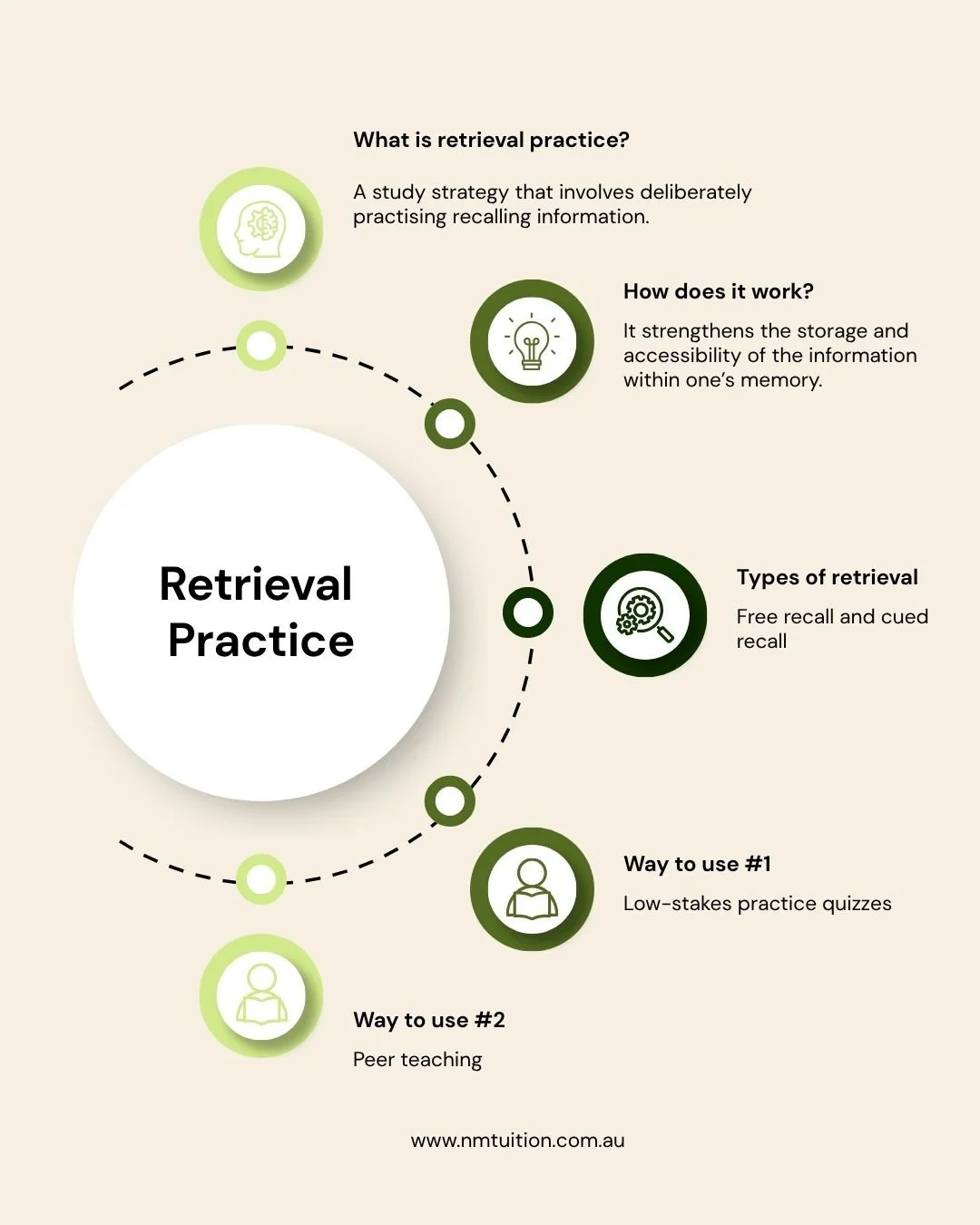
Retrieval practice is a study skill that involves deliberately practising recalling information.
Retrieval practice improves the retention of information in one’s long-term memory.
Low-stakes practice quizzes and peer teaching are effective ways that students can use retrieval practice to study.
What is Retrieval Practice?
Retrieval practice is an evidence-based study skill that involves deliberately practising recalling information from one’s memory.
This might involve attempting to recall the steps for solving a particular type of maths problem, remembering the key themes of a text when writing an essay or completing practice questions.
Retrieval practice is shown to significantly increase academic performance compared to more passive strategies such as reviewing class content, highlighting textbooks or rereading one’s notes.
How Does Retrieval Practice Work?
Practising recalling information strengthens one’s memory of that content by improving both storage strength and retrieval strength. Storage strength refers to how well a memory is embedded within one’s long-term memory networks (Bjork and Bjork, 2011). Retrieval strength refers to how accessible that memory is (Bjork and Bjork, 2011).
Retrieval practice also helps students evaluate their current level of understanding by identifying what they can recall well and where gaps remain.
Types of Retrieval
We can recall information from our memory using either free recall or cued recall:
Free recall: Involves bringing information to mind without any clues or support. Some examples of free recall are:
listing out all of the functions of proteins.
Recalling the themes of the novel ‘We Have Always Lived in the Castle’.
Cued recall: Involves recalling information with the help of cues or prompts related to the answer. Some examples of cued recall are:
The equation for photosynthesis is “carbon dioxide + water + ? “
Which organelle in a cell is responsible for the production of energy (Hint: it looks like a folded bean shape)?
Examples of Retrieval Practice
The following are practical ways that students can implement retrieval practice when studying:
Low-stakes practice quizzes: Practice quizzes are not just useful for evaluating one’s learning, they are a way to learn as well. Each time one recalls an answer to a question, that strengthens their memory of that knowledge.
Peer teaching: Peer teaching is a great study strategy as it helps students to explain content in their own words and actively recall their knowledge on a topic. It also allows students to compare their understanding with peers, helping them to identify knowledge gaps and deepen their understanding of content.
Want to upskill your students in retrieval practice?
Our ‘Effective Revision Strategies’ workshop covers in detail a number of practical ways that students can implement retrieval practice, as well as key factors to maximise the benefits of retrieval practice.
Learn more: https://www.nmeducation.com.au/study-skills-workshops